



In developed countries, almost 75% of the population consults a doctor at least once because of back pain.Nine out of ten people will experience back pain at least once in their lifetime.Most often, back diseases affect people between the ages of thirty and fifty, that is, of active working age.Of all patients who come to the clinic, more than a third come because of back pain.There are effective medications to relieve pain.
Types of back pain
Back pain is acute if it is located in the spine and has not started for more than six weeks.Acute pain is difficult for patients to tolerate, but in many cases it is a relatively benign symptom that can be treated.With timely treatment, patients return to professional activities within a month.
If the pain lasts more than six weeks, it becomes chronic, which is an equally dangerous problem, as there is a significant deterioration in the quality of life of patients of working age.The proportion of patients with chronic back pain is ten percent.
Reasons
It is important to note that the reasons for the development of pathological processes in the back have been studied quite well.Back pain can occur due to both risk factors and a developed disease.Most often, back and spine pain occurs when:
- overweight;
- muscle tension;
- injury to intervertebral joints;
- spasm;
- hypothermia;
- osteochondrosis;
- protrusion and hernia of the intervertebral disc;
- neuralgia.
It is well known that the presence of excess body weight significantly increases the load on the musculoskeletal system: the load on the lumbar spine increases by forty kilograms with an increase in body mass index by one unit.A sedentary lifestyle, prolonged exposure to a static position with incorrect posture and lack of physical activity lead to acute and chronic back pain.
Osteochondrosis
In the first place among the causes of back pain is spinal osteochondrosis.Spinal osteochondrosis is a pathological destructive process that develops in the intervertebral discs.As the disease progresses, the bodies of adjacent vertebrae, intervertebral joints and ligaments that support the spine are involved in the degenerative process.
Initially, the process develops in the core of the disc, which becomes less elastic due to the loss of moisture.These processes in a relatively localized area of the spinal segment lead to inevitable changes in adjacent vertebrae and intervertebral joints, which ultimately impair the mobility of the spine as a whole.
Disc herniation
Lumbar disc herniation is the most common.The patient feels pain in the back, which radiates to the leg, buttocks, reaches the foot or is located on the inner part of the thigh.
Mobility is limited.Sensitivity is impaired, which can occur in the form of burning and tingling.
Neuralgia
The presence of muscular neuralgia can be assessed by the appearance of sharp pain in the back.It occurs due to compression of the nerve under the influence of inflamed surrounding tissues.
The most common place for pain to occur is in the narrow spaces between the ribs at the back.Neuralgia occurs in both childhood and adulthood.
Injections for back and lower back pain
Today, the attending physician in matters of therapy is guided by data from scientific literature, his own experience and the experience of his colleagues, since there are no standards for the diagnosis and treatment of back pain that would be officially recommended by the Ministry of Health.
The following medications can be used to treat back pain:
- nonsteroidal anti-inflammatory drugs;
- steroid anti-inflammatory medications;
- muscle relaxants;
- chondroprotectors;
- vasodilators and improve microcirculation;
- synthetic drugs;
- B vitamins.
Nonsteroidal anti-inflammatory drugs
This group of medicines is indispensable for diseases of the musculoskeletal system.Sold without a prescription.
Available in the form of ointments, gels, tablets, suspensions, capsules, rectal suppositories, intravenous and intramuscular injections.
Prescribed:
- Anti-inflammatory from the group of phenylacetic acid derivatives with analgesic effect.Well tolerated and effectively relieves pain.Side effects include inhibition of proteoglycan synthesis in cartilaginous tissue and ulcerogenic properties, i.e., promotion of the formation of gastric ulcers.
- Anti-inflammatory of the sulfonamide class with analgesic effect.The difference from the previous remedy is the prevention of the destruction of proteoglycans and cartilage tissue, a selective effect on inflammatory mediators, which reduces the risk of gastric ulcers and enhances the effect of corticosteroids.Ideal for quickly relieving acute pain.Side effects include the risk of toxic liver damage.
Steroid anti-inflammatories
Used in cases where non-steroidal anti-inflammatory drugs do not have the desired effect.
They have a quick effect, have a systemic anti-inflammatory effect and reduce pain in the pathological focus.Available in the form of ointments, tablets, intramuscular, intravenous and intra-articular injections.
Used in severe cases.They are only available with a prescription because they have many side effects: weight gain, edema, osteoporosis, ulcerative processes in the stomach and intestines.
Muscle relaxants
They are used only as part of complex treatment with drugs from other groups.The action is based on muscle relaxation, that is, they themselves do not have a therapeutic effect.But muscle relaxation helps in the presence of prolonged spasms that cause pain and increases the effectiveness of manual therapy, massage and physiotherapy.
They are used both in conjunction with NSAIDs and in cases of intolerance to them or the presence of contraindications to them.
They are only available with a prescription, as they have side effects: sudden changes in blood pressure, convulsions, muscle weakness and a depressant effect on the central nervous system.
Chondroprotectors
These include glucosamine and chondroitin preparations.Chondroitin promotes calcium retention and slows bone resorption.Glucosamine helps improve the functions of the affected joint by increasing the production of hyaluronic acid.Available in the form of ointments, tablets, intramuscular and intra-articular injections.Prescribed in combination with NSAIDs.They have practically no contraindications or side effects.
In this case, for better effect, oral administration must be combined with parenteral administration:
- Injections for intramuscular administration: one ampoule three times a week for one to two months.
- Powder: dissolve in water and take half an hour before meals.Take one packet once a day for one to three months.
- Tablets: Take two tablets three times a day with meals.
Vasodilators
The medicine based on deproteinized blood products from calf blood helps to dilate blood vessels, reduce trophic and microcirculatory disorders, improving the supply of oxygen and nutrients.There is a decrease in hypoxia in the pathological focus with radiculopathies, osteochondrosis and intervertebral hernias.Available without a prescription in the form of tablets and injections.
Intravenous injections of a purine derivative are carried out in the morning and in the afternoon, 200-300 mg of the drug.Intramuscular injections are performed two to three times a day, 100 mg.The tablets, when taken simultaneously with the injections, enhance the effect of the medicine and are taken one tablet two to three times a day.
B vitamins
Used as part of complex therapy.Only three vitamins from this group are used.Thiamine is involved in energy metabolism, improves the conduction of nerve impulses, relieves pain and promotes the restoration of intervertebral discs.Pyridoxine prevents hypoxia and improves the trophism of intervertebral discs.Cyanocobalamin relieves inflammation, increases tissue trophism and restores the structure of nervous tissue.
Available without a prescription.They have practically no contraindications or side effects.Available in the form of tablets and injections.Use one ampoule a day for ten days.If the pain is not acute, a regimen is used in which 3 ampoules are used per week (every other day) for three to four weeks.
The above medications must be combined depending on the type of disease.But whatever it is, the main treatment will be aimed at eliminating pain, stopping inflammation and restoring the functions of the musculoskeletal system at the origin of the pathology.
The following are used as therapeutic measures:
- massage;
- manual therapy;
- physiotherapy;
- physiotherapy;
- electrical neurostimulation;
- therapeutic blockade;
- decompression and surgical stabilization.
Adequate therapy is prescribed by a general practitioner after a complete examination.If necessary, he will refer the patient to a specialist: neurologist, gynecologist, urologist.
Block for back pain
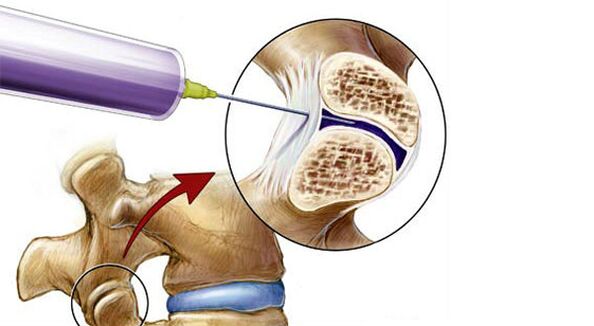
Carrying out paravertebral blockade makes it possible to ensure the delivery of the medicine directly to the pathological focus, which is the cause of acute pain.Patients experience immediate relief when the block is performed.But it can only be carried out in a hospital setting and only by a competent specialist.Pain relief is temporary but noticeable.The procedure also has diagnostic value.If there is no immediate pain relief after the block, the reason is not related to a spinal disease.
Blockade can be carried out in biologically active points of muscles and tendons, in soft tissues surrounding the affected segment of the spine, in nerve sheaths, in nerve ganglia, joints and joints.In this case, the injection consists of one, two, three or more medicines.These can be local anesthetics, corticosteroids, NSAIDs, vitamins, ATP.The effectiveness of blocks is undeniable for osteochondrosis, herniated discs, spondylosis and spondyloarthrosis, low back pain, radiculitis, acute and chronic back pain.
Blocking procedure
When carrying out a blockade with any of the above medications, the following are observed:
- immediate sensation of the effect on the part of the patient;
- almost complete absence of contraindications;
- creating a high concentration of the drug specifically in the pathological focus.
Description of the procedure:
- examination of the pathological focus with localization of the site of maximum pain;
- the patient is placed face down;
- treat the blockage site with an antiseptic;
- anesthesia of the puncture site and administration of the medication.
There are few contraindications for the block, but they exist: pregnancy, individual intolerance to medications, infection in the area of the procedure.
There are many ways to get rid of back pain.You should resort not only to pills or injections for back and lower back pain, but also remember about home remedies.First aid at home is to apply cold to the back (ice from the refrigerator, frozen meat, dumplings from the freezer).Painful spasm is relieved with massage.